
Low-maintenance landscape design for aging in place
By Rod Burnett · Updated 2026-07-20
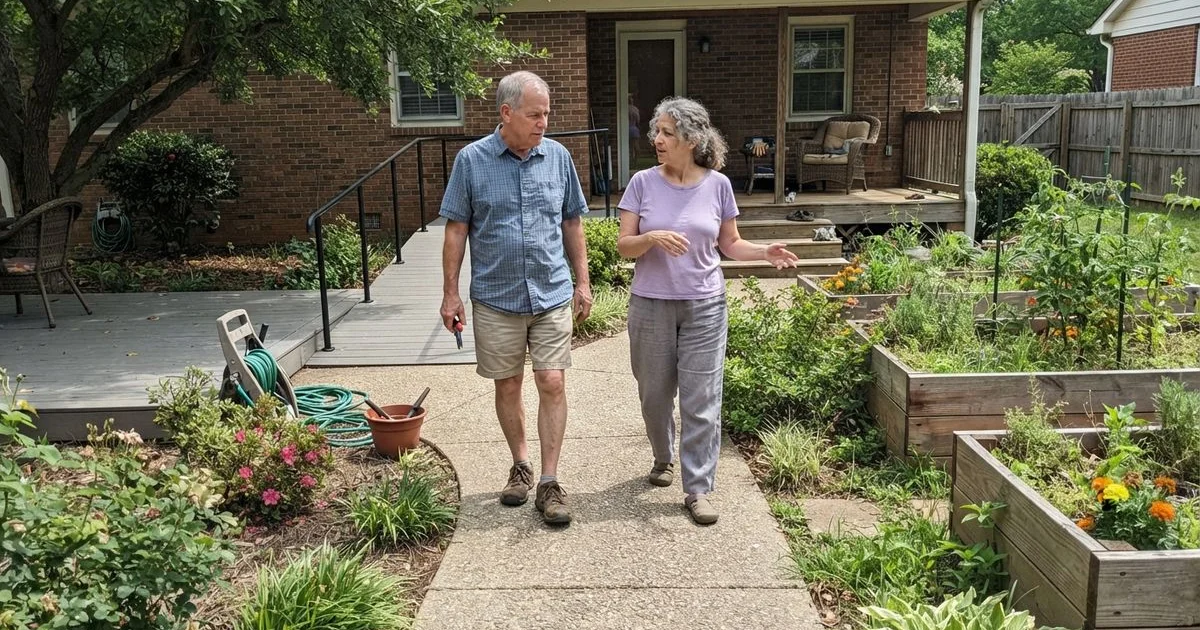
A yard that felt manageable at fifty can become a real burden at seventy-five, not because the person changed dramatically, but because mowing, bending to weed, and managing a complex planting scheme all get physically harder over time. A residential landscape design built around aging in place addresses this directly, rather than assuming the same yard will always be manageable.
Simplify the plant palette
The biggest maintenance driver in most yards is not any single plant, it is variety: a lot of different species, each with its own pruning schedule, watering need, and seasonal care. Reducing the number of distinct plant types and repeating a smaller set in larger masses cuts down on the mental load of remembering what each area needs, on top of reducing the physical work itself.
Reduce turf area where mowing is hardest
Lawn is one of the highest ongoing-maintenance elements of most yards, especially on any slope or in tight corners that are awkward to mow. Replacing turf in these harder-to-manage areas with groundcover, mulch, or a simple hardscape path reduces both the physical effort and the frequency of care needed, while still leaving a smaller, easier turf area for anyone who enjoys having some lawn.
| Design change | Maintenance benefit | Good fit for |
|---|---|---|
| Reduced plant variety, larger mass plantings | Less to track and prune differently | Most yards |
| Groundcover instead of turf on slopes | Removes difficult, hazardous mowing | Sloped or oddly shaped areas |
| Raised garden beds | Less bending and kneeling | Anyone who wants to keep gardening hands-on |
| Wider, gently sloped paths | Easier and safer to walk, supports mobility aids | Main walkways and entry paths |
Raised beds keep gardening accessible
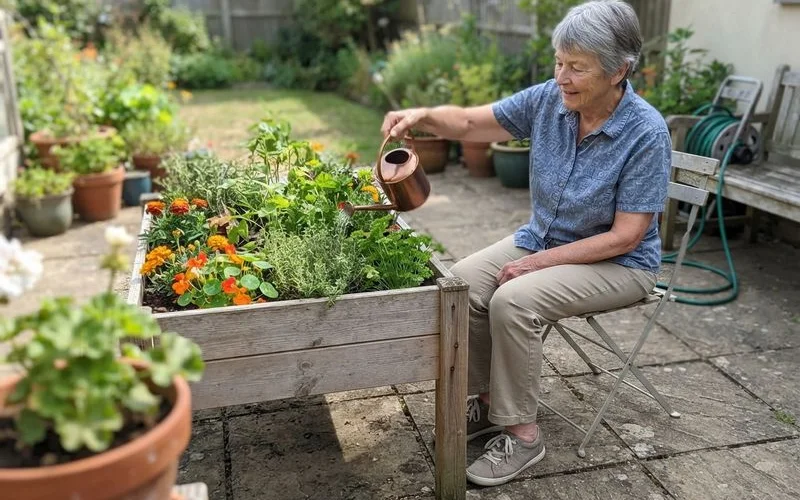
For homeowners who want to keep gardening rather than give it up entirely, raised garden beds built at counter height or a comfortable seated height remove most of the bending and kneeling a ground-level bed requires. This is a small design addition that preserves an activity many people genuinely enjoy, rather than removing garden beds altogether.
Paths and grading affect safety as much as looks
Wider paths with a gentle, even grade and a slip-resistant surface matter more here than in a typical design, since they support mobility aids like a cane or walker and reduce trip risk from uneven surfaces or steps. This usually does not require different materials, just different dimensions and more attention to consistent grading, which keeps the added cost modest.
Irrigation reduces daily upkeep
A simple, well-designed irrigation system removes daily watering from the list of physical tasks, which matters more as manual watering with a hose becomes harder to manage. Pairing efficient irrigation with a reduced, low-water plant palette compounds the benefit, since there is both less to water and an automated way to do it. Budget is often part of this decision too; see our guide on free and low-cost landscape design help if cost is the main barrier to getting started.
You do not need to start over
Most existing yards can move toward a lower-maintenance design in phases rather than a full teardown. Start with whatever is currently hardest to manage: a steep mowing strip, a bed with a dozen different plant types, an uneven path, and address that first. A designer can build a phased plan that improves the yard’s manageability step by step rather than all at once.
Compare designers experienced with accessible and low-maintenance design from our home page, and see our methodology for how listings here are evaluated.
FAQ
- What makes a landscape design genuinely low maintenance, not just low water use?
- Fewer distinct plant types, larger mass plantings instead of many small individual beds, groundcover instead of turf in hard-to-mow areas, and hardscape or mulch in place of areas that would otherwise need regular trimming.
- Are raised garden beds worth adding for an aging homeowner?
- Often yes, since they reduce bending and kneeling for anyone who still wants to garden hands-on, and they can be built at a height that works from a standing or seated position.
- Do accessible paths cost significantly more to design?
- Not usually. Wider, gently sloped, slip-resistant paths often use the same materials as a standard path, just planned with slightly different dimensions and grading, which adds modest cost rather than a major one.
- Can an existing high-maintenance yard be converted, or does it need a full redo?
- Most yards can be converted in phases, replacing the highest-maintenance areas first, like large turf sections or a bed with many different plant types, rather than requiring a full teardown and rebuild.